First, a bit of honesty:
As we Thrasher bloggers gathered rinkside at the IceForum to be led for Media Availability, I was a little concerned. I had done research, but was it enough? This was the first time I had ever interviewed someone on any level, and then I planned to throw the results up on the internet for the world to see. Fortunately, it didn't end up a total trainwreck, and a lot of the credit needs to go to John Albert. He was engaging and easy to talk to. Once we got into a little bit of a rhythm, I began to remember some of the things I had read in my research, and quickly discarded some of the, um, lesser questions I had hastily scribbled at the last minute (unfortunately, that means we are deprived of learning Mr. Albert's favorite sandwich topping; my apologies).
To really get an idea of John as a player, you really don't have to go any further than this quote from Thrashers Director of Scouting Dan Marr:
Johnny is an old fashioned hockey player. He has that knack for being in the right place at the right time. He knows what the situation calls for and he makes the plays. If it is the type of game where it is about speed and skill, if it is a game where you have to fight one-on-one battles to get through--he will grit it out. He's a little back of throw back--a natural--his hockey instincts are very natural.
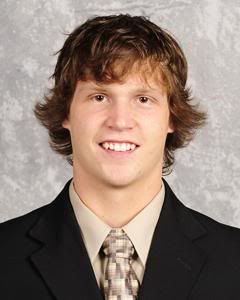
John may not be a big guy (5'11", 180lbs), but he has good legs and soft hands. He talked about being a play-maker, and you can see it in his game. He's a bright kid with an even brighter hockey future ahead of him. I really look forward to seeing John more at camp and (hopefully) in a Thrashers sweater.
You went to college versus going the junior hockey route; can you talk a little bit about that decision? I think education is a very important part of life right now. With the economy, it's always good to get a degree. School is the number one priority for me and my family - it was a big thing for us that I get an education. I've been a life-long Ohio State Buckeye at heart, so it was a great opportunity for me to go to a school that I love.
 What do you think that you're getting out of going to school, other than the education? There's talk about players coming out of college having a different hockey mindset going in the game, rather than having spent their whole lives just playing in juniors. Is there a difference in the way that you view the game now?
Not necessarily. I think that, obviously, every high level you play at, whether it's OHL or college, there's great competition, so I think either is going to get you prepared for the NHL. The best thing about going to college is obviously the education, and that was the biggest thing to me. I think we have a great strength coach there at Ohio State, and getting stronger is a big part of playing in the NHL.
You were a sophomore this past year. I read a lot about how your coach wanted a little more out of you and a couple of other guys on the team. What did you learn from that as far as being a leader, as far motivating guys, kind of at a young age, but still having to step into a leadership role?
Yea, I'm very young myself, and having to be a leader on the team as a sophomore was a hard thing for me to kind of first grasp. When I got in there my sophomore year, they told me they wanted me to be one of the leaders on the team. We didn't have very many upperclassmen, so being a leader on the team taught me to keep my composure, be confident all the times, have a good attitude in the locker room, because the younger guys reflect off of that. If I come in with a bad attitude, they all come in like, “Well, if he has a bad attitude..” Having a positive attitude is the best thing, and encouraging guys to do better, even if it's not such a good play, just telling them, “Well get 'em next time.” I learned a lot of leadership skills that hopefully I can take into my junior year.
You guys definitely improved this year over last year. What was that due to? Was it everybody just stepping up?
Yea, we played as a team. That was the most important thing: we didn't have any individuals on the team. Everyone got along well; you play with your linemates, and you have good chemistry throughout all four lines. We did have a good attitude the whole year, we tried to stay as even-keel as possible. We had some rough games, but we bounced back the next weekend. We had a lot of come-from-behind victories which helped our team out towards the end of the year. It gave us confidence that when we are down, we know we can come back.
Some of the bloggers were talking, and it was mentioned that another blogger talked to Dan Marr, one of the scouts for Atlanta, and Dan's eyes lit up when your name was mentioned. Do you feel any kind of expectation for this year, or is there a bar that you feel you need to reach?
I think I just have to try my hardest, give my best effort, work hard, and I think they'll appreciate that. That's why we're here; we here to show them how hard we could work and the skills we have. If I work hard, I think they'll appreciate that.
OSU isn't necessarily a “hockey school.” You guys were playing a barn that wasn't always all that full at home. Can you talk a little bit about how that affects you as a player?
If you think about it, I think we averaged about 4,000-5,000 fans a game [4,181 to be exact]. Our building holds 17,000, so [the crowd] looks small to us, and it looks small to other teams, but relatively, around the league, I think we're up there with smaller barn teams. If we had a smaller barn, we'd fill it pretty good. Playing a big barn like that, it's kind of a disadvantage, but our fans were great this year. They were really good for us. We played really good at home, and we had a very good home record [13-5-2], so I think they appreciate that. When you play good, you'll have fans in the crowd. We just went out there every night, and tried to play the best we could and the fans came for us.
You saw a lot more work on the power play, especially at the point. Was that a coach that pushed you there, or was that something that you wanted to do?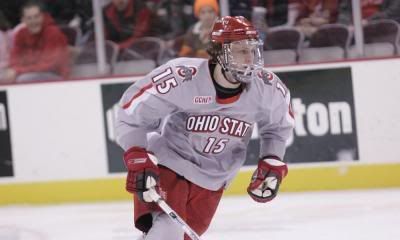
It was kind of both. Being on the power play is an honor, and I really don't care where I play on the power play as long as I can help the team out. The coach decided to put me there, he just told me to shoot the puck, he said I had some good vision, so I tried to dish the puck to an open player. Even if I'm playing on the half wall in front of the net I'm going to try my hardest and do whatever I can for the team.
What part of your game do you want to work the most on? What do you think you need to improve on?
I think defense. I had a pretty strong defensive year last year, I was up there [+12], and it was a big improvement from my freshman year. I think my freshman year was -3, or something like that. I was a big improvement for me, but I still need to work on it. I'm getting better knowing what I need to do down there. Obviously, good defense turns into good offense.
I read that the player you'd like to play with the most is Sidney Crosby?
Yea... I think he's probably the best player in the NHL. He has great vision, very smart on the ice, it would just be an honor to play with him. I think he'd teach you a lot out there.
Is that who you style your game after?
No, not necessarily. I just think he's a really good player.
How do you see yourself, then? What are some names you'd throw out there to compare yourself to?
I don't know... I'm small, so Martin St. Louis. I'm a small guy, I'm quick, I try and score as many goals as I can, even though I'm a playmaker.
What is your favorite team?
Um, Atlanta.
Good job. In my blog, I talk about some other things sometimes, like music. Are there any bands that you listen to to get you amped up and ready to play?
No, not necessarily. I'm not that kind of guy. I think I'm ready for every game. If I do listen to music, it's always country. I don't listen to anything but country.
Cool. Well, you'll find a lot of that down here.
Yea, I'm a big country fan.
...and that's where our interview was awkwardly concluded by my meek statement of, “Um... I think I'm done.”
Um, I think I'm done.